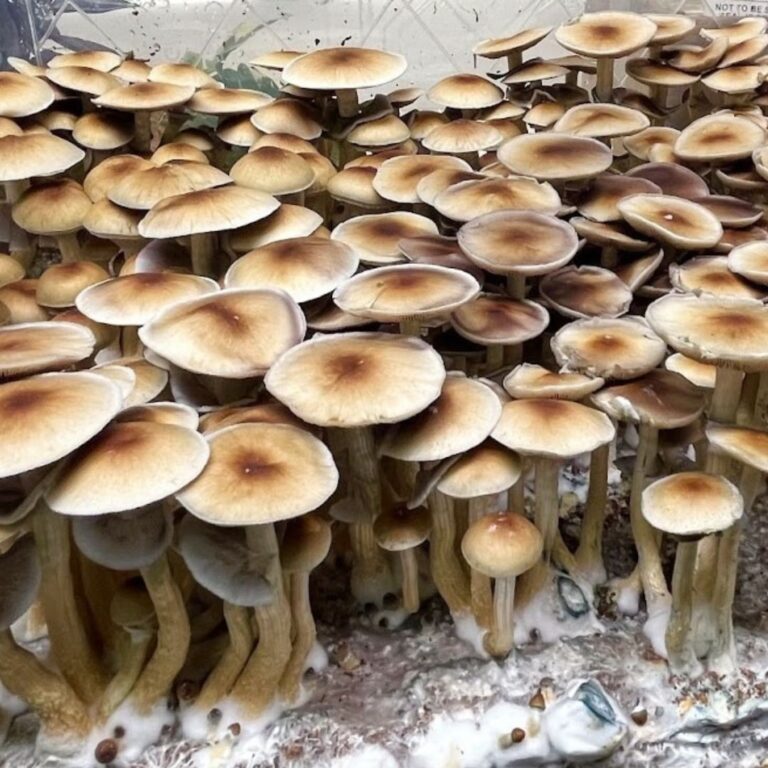
Psilocybe cyanescens, commonly known as “wavy caps,” “blue halos,” or simply “cyans,” is a potent psychedelic mushroom prized for its distinctive appearance and strong effects. While perhaps not as culturally steeped in ancient traditions as Psilocybe cubensis, P. cyanescens has carved out its own niche, particularly in temperate regions around the globe. Let’s delve into the world of Psilocybe cyanescens and explore its characteristics, history, and what makes it so unique.
A Relatively Recent Discovery: The Story of P. cyanescens
Unlike Psilocybe cubensis with its deep roots in Mesoamerican history, Psilocybe cyanescens has a more recent documented history in Western mycology. It was formally described relatively recently in 1946 by mycologist Elsie Wakefield, based on specimens she collected at the Royal Botanic Gardens, Kew, in England. However, her collections of this species actually began as early as 1910, indicating it was present and noticed well before its formal classification.
While P. cyanescens may not have the same extensive ethnographic record as some other psychedelic mushrooms, the Psilocybe genus itself has a broader history of use, as highlighted by recent studies on the diversity of “magic mushrooms” and their significance in indigenous Mesoamerican cultures for centuries. These studies underscore the long-standing human relationship with psilocybin-containing fungi, even if the specific history of P. cyanescens is less detailed. It rose to broader attention as part of the psychedelic movement of the 1960s and 70s and continues to be of interest today, particularly in the context of mental health research.
Identifying the Wavy Cap: Appearance in the Wild
Psilocybe cyanescens is aptly named for its most striking feature: the wavy cap. Here’s a closer look at its key characteristics:

- Cap: The cap is typically 1.5 to 6 cm (sometimes up to 8 cm) in diameter. When young, it starts conical or bell-shaped, gradually becoming convex and eventually flattening with age. The margin, or edge of the cap, becomes distinctly wavy and undulating as it matures – this “wavy cap” is a hallmark of the species. The cap surface is smooth and viscid (slimy) when moist. Coloration changes with hydration: when moist, it’s a chestnut brown to caramel brown, fading to tan, yellowish-brown, or ochraceous as it dries. A key identifying feature, like other psilocybin mushrooms, is the blue bruising. P. cyanescens readily bruises blue-green, especially at the cap margin and center, and the entire cap can take on a dark blue-brown hue with age. You may even see the gills showing through the cap as lines.
- Gills: Located under the cap, the gills are moderately crowded and broadly attached to the stem or slightly notched (adnate to subdecurrent). They start pale tan, developing dark spots and eventually becoming a dark purple-brown. They also bruise blue when damaged.
- Stem: The stem is slender, typically 4 to 9 cm long and 0.25 to 0.8 cm thick, and cylindrical, sometimes slightly wider at the top. It has a whitish color initially but bruises blue to bluish-green when handled or damaged. The stem surface is covered in silvery fibers.
- Veil: P. cyanescens has a fibrillose or cobwebby veil, remnants of which may be visible as threads on the cap margin and stem as the cap opens. It does not leave a prominent ring on the stem like some other mushrooms.
- Spores: The spores are dark purplish-brown to purple-gray or purple-black, elliptical, and smooth, measuring 9-12 x 5-9 microns.
- Odor: Psilocybe cyanescens has a distinctive odor, often described as similar to freshly cut green beans or flour.
- Habitat: P. cyanescens is saprotrophic, meaning it feeds on decaying organic matter. It’s particularly common on wood chips and woody debris, especially in urban environments, parks, and mulched plant beds. It favors lignin-rich substrates and is less common in bark mulch or non-woody environments.
- Geographical Range: Originally thought to be native to the Pacific Northwest region of North America, P. cyanescens is now found in a wider range, including coastal western North America (from British Columbia to California), parts of the Eastern USA, widespread in Europe, New Zealand, and parts of West Asia (Iran). Its range is expanding, possibly due to the global distribution of wood chips and mulch.
- Fruiting Conditions: Fruiting is triggered by a drop in temperature, typically in the fall when temperatures are between 10–18 °C (50–64 °F). In areas like the San Francisco Bay Area, fruiting season is typically late October to February. P. cyanescens often fruits in large groups or clusters, sometimes in impressive numbers.
Variants and Look-alikes: Navigating the Cyanescens Landscape
When it comes to variations within Psilocybe cyanescens, the concept of distinct “strains” or cultivated variants is not as developed as with Psilocybe cubensis. P. cyanescens is more often discussed in terms of wild collections and regional variations.
However, within the Psilocybe cyanescens “complex,” there are closely related species that share similar appearances and habitats. These include:
- Psilocybe allenii: Very similar to P. cyanescens but the cap margin is less wavy, remaining convex with a central bump. It also grows on wood chips in urban environments.
- Psilocybe azurescens: Another potent species in the complex. P. azurescens has a cap that is hemispheric when young, convex when mature, but never wavy. It has a longer stem than P. cyanescens and fruits later in the year (late September to April).
- Psilocybe pelliculosa: Smaller than P. cyanescens, with a bell-shaped cap that doesn’t become wavy. It contains less psilocybin than P. cyanescens.
It’s crucial to be able to distinguish Psilocybe cyanescens from potentially deadly look-alikes, especially Galerina marginata. Galerina marginata is a toxic mushroom that also grows on wood chips and can bear a superficial resemblance to P. cyanescens. Key differences to note:
- Stem Bruising: P. cyanescens stems bruise blue-green; Galerina marginata stems do not bruise blue and instead may turn blackish with age.
- Cap Waviness: P. cyanescens has a distinctly wavy cap margin; Galerina marginata caps are not typically wavy.
- Ring: Galerina marginata has a more distinct, fibrous ring on the stem than P. cyanescens.
- Spore Print: Psilocybe spores are dark purplish-brown; Galerina spores are rusty brown or cinnamon brown.
Potency and Practicalities
Psilocybe cyanescens is considered a potent psychedelic mushroom, often described as more potent than Psilocybe cubensis. It contains psilocybin, psilocin, and baeocystin. North American specimens have been shown to have higher indole content than European ones. Potency can vary, but even a small amount of dried P. cyanescens can produce significant psychedelic effects.
While P. cyanescens can fruit prolifically in the wild, cultivation can be more challenging than P. cubensis, especially indoors, due to its specific fruiting requirements (cool temperatures). Outdoor cultivation in suitable climates is more feasible. Yields are generally lower compared to P. cubensis.
Modern Relevance
Like other psilocybin-containing mushrooms, Psilocybe cyanescens is of interest both for recreational and potential therapeutic use. Its potency makes it sought after by experienced users. Research into psilocybin’s therapeutic applications, while not always species-specific, encompasses the potential of compounds found in P. cyanescens.
In conclusion, Psilocybe cyanescens, the “wavy cap,” is a fascinating and potent mushroom with a distinctive appearance and a growing global distribution. Its potency and unique fruiting habits set it apart in the world of psychedelic fungi.
Please remember: Foraging for wild mushrooms carries risks, including misidentification of toxic species. Always be 100% certain of your identification before consuming any wild mushroom, and consult with expert mycologists if you are unsure. Cultivation and use of psilocybin mushrooms are subject to legal regulations that vary significantly across jurisdictions. It is essential to be aware of and comply with the laws in your region.