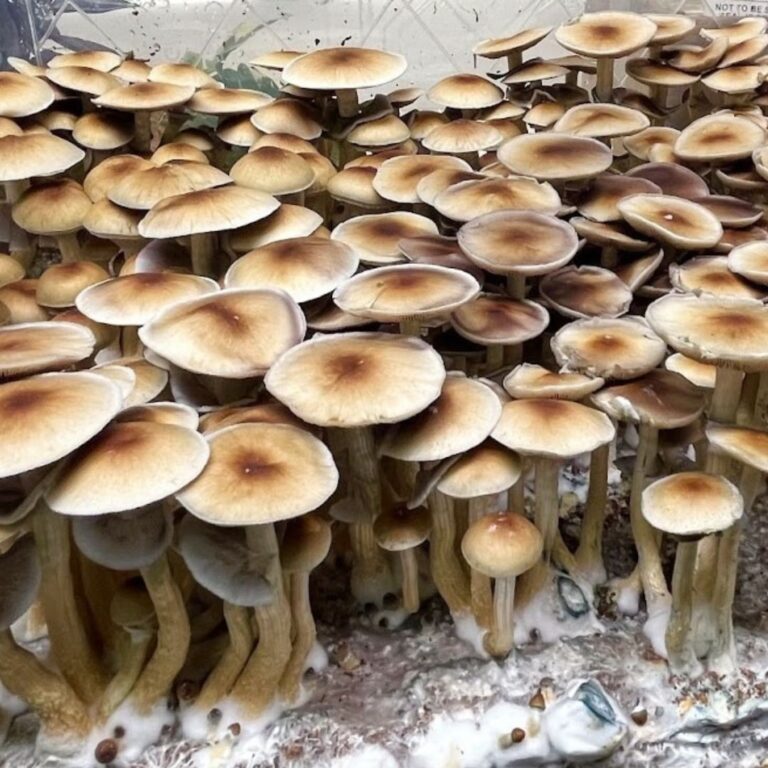
Panaeolus cyanescens, often known as “Pan cyans,” “Blue Meanies,” or “Hawaiian Copelandia,” is a potent psychedelic mushroom species that, while less widely cultivated than Psilocybe cubensis, holds its own fascinating place in the world of entheogenic fungi. Let’s explore the story of Panaeolus cyanescens, from its natural characteristics to its cultural significance and the limited world of its variations.
A Different Lineage: Panaeolus vs. Psilocybe
It’s important to start by noting that Panaeolus and Psilocybe are distinct genera within the fungal kingdom. While both contain psilocybin and psilocin, they are not as closely related as different species within the same genus. Panaeolus mushrooms, in general, are known to be more challenging to cultivate than Psilocybe cubensis, which contributes to their relative lesser popularity in home cultivation circles.

Historical and Cultural Context: Traces in Tradition
Unlike Psilocybe cubensis, Panaeolus cyanescens does not have the same well-documented, deep historical connection to ancient Mesoamerican cultures. While there’s evidence that various Psilocybe species were used in rituals, direct evidence linking Panaeolus cyanescens to these ancient practices is less clear.
However, Panaeolus species, including cyanescens, are found in tropical and subtropical regions around the world. It’s plausible that indigenous cultures in these regions, particularly in areas like Southeast Asia and parts of the Americas where Panaeolus cyanescens naturally occurs, may have had their own traditional uses for these mushrooms. However, specific ethnographic records are less readily available compared to those for Psilocybe.
The “Hawaiian Copelandia” moniker hints at a more recent history. Panaeolus cyanescens gained prominence in psychedelic circles particularly after being found growing in abundance in Hawaii in the 1970s. This discovery, coupled with the increasing interest in psychedelics, brought Panaeolus cyanescens into broader awareness in the West.
Appearance of Wild Panaeolus cyanescens
Panaeolus cyanescens has a distinct appearance that sets it apart from Psilocybe cubensis. The cap is typically conical to bell-shaped, expanding slightly with age but often retaining a more pointed form than the broadly convex cap of P. cubensis. Caps are smaller, generally ranging from 1 to 4 cm in diameter, and are smooth and thin. Coloration is a key identifier: Panaeolus cyanescens caps are typically a light tan to grayish-brown when young, fading to a pale gray or almost white as they dry, often with bluish or grayish tones, especially towards the margin. Like Psilocybe cubensis, Panaeolus cyanescens also exhibits a blue bruising reaction when handled, indicating the presence of psilocybin.
The stem is slender and fragile, typically 5 to 12 cm tall and only 0.2 to 0.5 cm thick. It is usually a pale yellowish to whitish color, also bruising blue when damaged. Unlike Psilocybe cubensis, Panaeolus cyanescens lacks a veil and therefore does not have a ring on the stem. The gills are adnate (attached to the stem) and start out light gray, maturing to black as the spores darken. A key characteristic of Panaeolus spores is that they are black and smooth, which is a distinguishing feature under a microscope.
Ecologically, Panaeolus cyanescens is also a dung-loving species, favoring rich, grassy pastures and fields fertilized with manure, particularly in tropical and subtropical climates.
Are There Panaeolus cyanescens Variants? The Landscape of Diversity
When it comes to Panaeolus cyanescens variants, the situation is quite different from Psilocybe cubensis. Due to its less common cultivation and perhaps less intense selection pressure from cultivators, named and stabilized variants of Panaeolus cyanescens are not as prevalent. The concept of “strains” as understood in Psilocybe cubensis cultivation is less defined for Panaeolus cyanescens.
However, this doesn’t mean there’s no variation within Panaeolus cyanescens. Like any species, Panaeolus cyanescens exhibits natural genetic diversity. Different wild collections from various geographic locations will likely show some degree of phenotypic variation (differences in appearance and growth). These differences might include subtle variations in cap color, size, stem thickness, growth rate, and potency.
One such isolation is the TTBVI Pan Cyan. This potent variation is a reginal variant that was collected growing under a Tamarind tree in the British Virgin Islands. This specimen is known for very high potency.
Another variation of the Pan Cyan is the MIB, which is a cross of three panaeolus cyanescens variants, PHV x BVI x Nec-D, created by Magic Myco.
It’s also worth noting that the term “Blue Meanies” itself is sometimes used somewhat loosely and can refer to different isolations of Panaeolus cyanescens. There isn’t a single, universally recognized “Blue Meanies” strain with a definitively documented lineage in the same way as, for example, Albino Penis Envy in P. cubensis.
“Blue Meanies” and Potency
The name “Blue Meanies” is often associated with Panaeolus cyanescens due to its tendency to bruise intensely blue and its reputation for high potency. Panaeolus cyanescens is generally considered to be more potent than Psilocybe cubensis on a gram-for-gram basis. This higher potency is due to a higher concentration of psilocybin and psilocin.
While specific potency can vary between individual mushrooms and different collections, Panaeolus cyanescens consistently ranks among the more potent psilocybin-containing mushrooms. This potency is a significant factor contributing to its appeal among experienced psychonauts.
Modern Usage and Research Gaps
Today, Panaeolus cyanescens is primarily sought after by experienced psychedelic mushroom enthusiasts due to its potency. It is less commonly cultivated at home compared to Psilocybe cubensis due to its more demanding cultivation requirements.
Research into the therapeutic potential of psilocybin is largely focused on psilocybin in general, rather than specifically on Panaeolus cyanescens. However, any research on psilocybin’s therapeutic applications is indirectly relevant, as Panaeolus cyanescens is a natural source of this compound.
In conclusion, Panaeolus cyanescens is a fascinating and potent psychedelic mushroom with its own distinct story. While it lacks the extensive cultural history and varietal diversity of Psilocybe cubensis, its higher potency and unique characteristics make it a noteworthy species in the world of psychedelic fungi.
Please remember: Cultivation and use of psilocybin mushrooms are subject to legal regulations that vary significantly across jurisdictions. It is essential to be aware of and comply with the laws in your region.