The Mighty Psilocybe Cubensis: A Journey Through Time and Cultures
Psilocybe cubensis, often affectionately called “cubes” or “magic mushrooms,” isn’t just another fungus in the forest. It’s a species with a rich history, a fascinating appearance, and a whole family of intriguing variations. Let’s take a trip through time and explore this remarkable mushroom, from its ancient roots to its modern-day forms.
Echoes of the Past: P. cubensis in Ancient Cultures
The story of Psilocybe cubensis is deeply intertwined with human history, particularly in Mesoamerica. Archaeological evidence suggests that psychedelic mushrooms, likely including Psilocybe species, were used in rituals and ceremonies as far back as 3,000 years ago. Ancient cultures like the Aztecs and Mayans in Central and South America revered these “magic mushrooms,” referring to them as “teonanácatl,” meaning “flesh of the gods” in the Nahuatl language.
These weren’t just recreational substances; they were considered sacred tools for spiritual communion, divination, and healing. Imagine Aztec rulers being served these mushrooms at their coronation ceremonies in 1502! Mushroom stones and motifs found in Guatemala and pre-Columbian sculptures throughout the Americas further solidify this deep cultural connection.
However, with the arrival of Spanish conquistadors in the 16th century, this rich tradition faced suppression. Catholic missionaries, viewing the practice as idolatry and demonic, attempted to eradicate the use of hallucinogenic plants and mushrooms. Despite these efforts, the use of “teonanácatl” persisted in remote indigenous communities, particularly among groups like the Mazatec people of Oaxaca, Mexico. It was María Sabina, a Mazatec curandera (healer), who played a pivotal role in introducing these sacred mushrooms to the Western world in the mid-20th century.
Modern Rediscovery and the Rise of P. cubensis
While indigenous cultures maintained their traditions, the Western world remained largely unaware until the 20th century. The first mention in European medicinal literature dates back to 1799, but it wasn’t until the mid-1950s that Psilocybe mushrooms truly entered Western consciousness. The pivotal moment came when amateur mycologist R. Gordon Wasson and his wife Valentina Pavlovna Wasson participated in a Mazatec mushroom ceremony in 1955. Their subsequent publications, most notably a 1957 Life magazine article, brought the psychedelic experience and the Psilocybe mushroom to the attention of a global audience.
Following the Wassons’ groundbreaking work, Roger Heim identified the psychoactive mushroom they brought back from Mexico as Psilocybe, and in 1958, chemist Albert Hofmann (the same chemist who first synthesized LSD) identified psilocybin and psilocin as the active compounds responsible for the mushroom’s effects. This scientific identification and the popularization of “entheogens” by figures like Timothy Leary and Terence McKenna led to an explosion in the use and interest in Psilocybe cubensis and other psychedelic mushrooms worldwide.
By the 1970s, numerous Psilocybe species were being identified across the globe, and importantly, methods for cultivating Psilocybe cubensis were being developed and shared through publications. This ease of cultivation, combined with its psychoactive properties, cemented P. cubensis as one of the most widely used psychedelic mushrooms.
What Does a Wild P. cubensis Look Like?
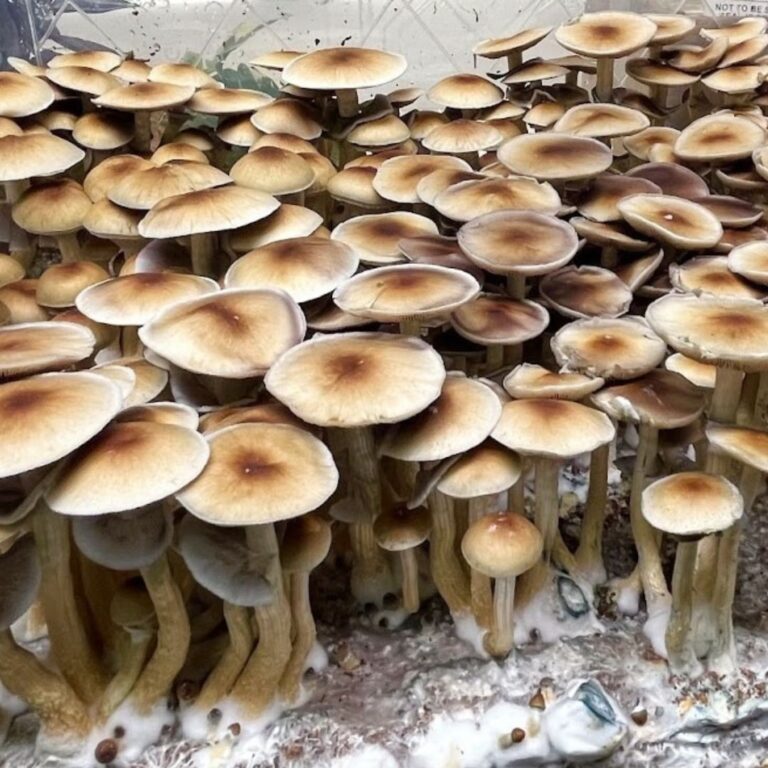
If you were to stumble upon Psilocybe cubensis in its natural habitat, here’s what you might see. The “cubensis” part of the name hints at its cap, which is typically convex or bell-shaped when young, gradually flattening out with age, sometimes even becoming slightly upturned at the edges. Caps usually range from 2 to 8 cm (sometimes larger) in diameter and boast a reddish-cinnamon brown color when young, fading to golden brown or yellowish as they mature. Often, you’ll notice a bluish bruising reaction when the mushroom is handled or damaged – this is a key indicator of psilocybin content.

The stem is usually whitish to yellowish, stout, and can grow from 4 to 15 cm tall and 0.5 to 1.5 cm thick. A distinctive feature is the veil, a membrane that connects the cap to the stem in young specimens. As the mushroom matures, this veil breaks, leaving behind a ring or annulus around the upper part of the stem. The gills underneath the cap start out whitish to grayish, darkening to purplish-brown as the spores mature.
P. cubensis is a dung-loving species, meaning it thrives on the dung of herbivores, particularly cattle. This preference for manure-rich environments is a crucial ecological characteristic. Originally thought to be primarily from the Psilocybe genus, current research indicates that psilocybin synthesis might have arisen much earlier in fungal evolution, with Psilocybe representing a genus where this trait became particularly prominent.
The Amazing World of P. cubensis Variants
Now, let’s dive into the fascinating realm of P. cubensis variants. Thanks to both natural mutations and dedicated cultivation efforts, a diverse array of P. cubensis varieties has emerged, each with its own unique characteristics. These variations often involve changes in appearance, growth patterns, and even reported potency. It’s important to note that while anecdotal reports sometimes claim significant potency differences between variants, scientific evidence for this is still developing, and subjective experiences can vary widely.

Here are a few examples of well-known P. cubensis variants:
- Albino Penis Envy (APE): Perhaps one of the most famous and visually striking variants. APE is known for its short, thick, albino (or nearly albino) stems and underdeveloped caps. It’s a mutation that arose from the Penis Envy strain and is often reported to be more potent than standard P. cubensis.
- Penis Envy (PE): The parent strain of APE, Penis Envy is also known for its unique morphology, with a thick stem and a small, often nipple-shaped cap that doesn’t fully open. It’s also widely considered to be more potent than typical P. cubensis strains.
- Jack Frost: A relatively newer and visually stunning hybrid variant. Jack Frost is known for its frosty white caps that sometimes exhibit bluish hues, contrasting with bluish-grey gills. It’s a cross between Albino Penis Envy and True Albino Teacher strains. This variant is attributed to Dave Wombat.
- Yumbo: A less commonly discussed but interesting variant. Yumbo is the first species cross, and is a result of crossing P. cubensis with P. Natalensis genetics. This cross is attributed to Yoshi.
- Golden Teacher: A very popular and widely cultivated strain, known for its golden-brown caps and ease of growth, making it a favorite for beginners in mushroom cultivation.
- B+ (B Plus): Another beginner-friendly and prolific strain. B+ is known for its adaptability to different growing conditions and produces large, fleshy mushrooms.
- Amazonian: As the name suggests, this strain is rumored to originate from the Amazon rainforest. It’s known for its fast colonization and fruiting times, and resilience.
- Thai Pink Buffalo: A strain originating from Thailand, known for its reddish-brown caps and aggressive mycelial growth.
This is just a small glimpse into the vast world of P. cubensis variants. Breeders and cultivators are constantly working to isolate new mutations and create unique hybrids, leading to an ever-expanding array of forms and characteristics.
Modern Usage and Research
Today, Psilocybe cubensis continues to hold significance, albeit in a different context in many parts of the world. While still used recreationally, there’s a resurgence of interest in its therapeutic potential. Modern clinical research is exploring psilocybin, the active compound in P. cubensis, for its potential to treat conditions like depression, anxiety, PTSD, and addiction. Studies have shown promising results, suggesting that psilocybin-assisted therapy could offer new hope for mental health treatment.
It’s a remarkable journey for Psilocybe cubensis, from its ancient sacred use, through periods of suppression, to its modern rediscovery and exploration in both recreational and therapeutic contexts. This humble dung-loving mushroom continues to captivate and intrigue, offering a glimpse into both the depths of human history and the frontiers of consciousness research.
Please remember: Cultivation and use of psilocybin mushrooms are subject to legal regulations that vary significantly across jurisdictions. It is essential to be aware of and comply with the laws in your region. This article is for research and informational purposes only.