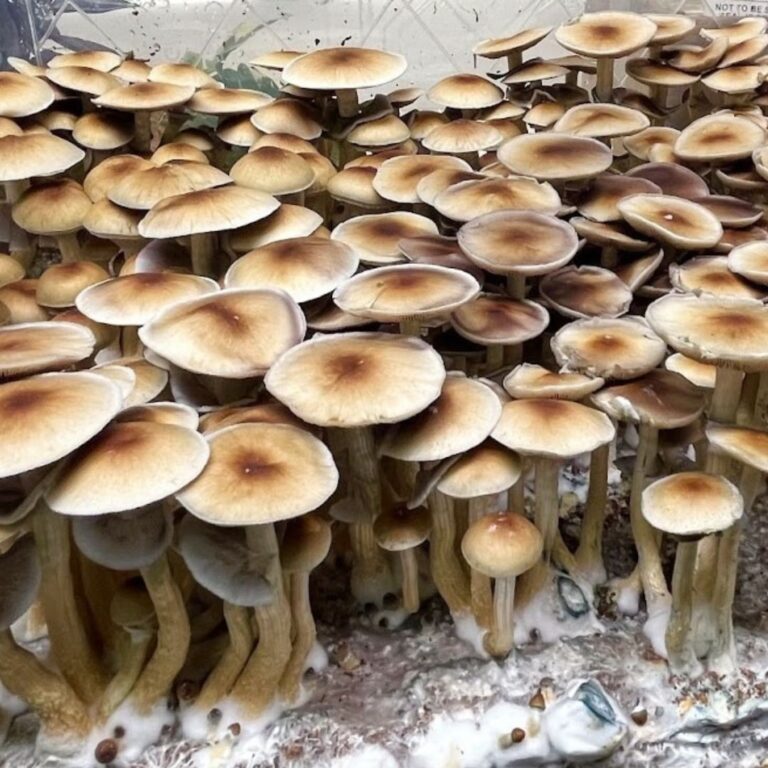
Psilocybe natalensis, a lesser-known but increasingly popular species within the Psilocybe genus, is native to South Africa and has a reputation for its unique psychoactive effects. This article explores P. natalensis in detail, covering its history, appearance, potency, and how it compares to other species like Psilocybe cubensis.

Origin and History of Psilocybe Natalensis
P. natalensis was first described by German mycologist Ewald Gerhardt in 1992. This species was discovered in the subtropical climate of South Africa, specifically in the Natal region, from which it derives its name. Despite being less widely recognized than Psilocybe cubensis—a global favorite—P. natalensis has gained attention among mycology enthusiasts due to its potency and distinct characteristics.
Physical Characteristics and Identification
Psilocybe natalensis mushrooms have a unique appearance, allowing them to be distinguished from other Psilocybe species. Their caps are typically convex to conical, often presenting a light tan or caramel color that can deepen with maturity. The caps may develop small, darkened spots, and a characteristic blue bruising often appears when the mushroom is handled or damaged, a sign of its psilocybin content.
The stems of P. natalensis are slender, white to off-white, and slightly curved, reaching up to 12 cm in height. Unlike some other species, P. natalensis has a tendency to grow in clusters rather than as single mushrooms, especially in humid environments with decaying vegetation and rich organic matter.
Psychoactive Potency and Effects
Psilocybe natalensis is generally considered to have a potent psychoactive profile. Though precise psilocybin and psilocin content can vary by specimen and environmental conditions, anecdotal reports and some preliminary studies suggest that P. natalensis may be stronger than P. cubensis, a widely known species. The effects of P. natalensis are reportedly more intense and longer-lasting, with users experiencing pronounced visual and emotional shifts.
It’s important to note that research on P. natalensis is limited compared to other species like P. cubensis and Psilocybe cyanescens. Much of the information available comes from self-reported experiences, which may vary widely.
Comparisons with Other Psilocybe Species
While P. natalensis and P. cubensis share many similarities, they have distinct differences in appearance, potency, and regional origin. Some notable differences include:
- Appearance: P. natalensis mushrooms tend to be slightly more delicate in structure and lighter in color than P. cubensis. Additionally, P. natalensis often grows in smaller, denser clusters.
- Potency: Anecdotal reports and some early testing indicate that P. natalensis may be stronger than P. cubensis, delivering a more intense experience.
- Environment: P. natalensis is naturally adapted to the subtropical climate of South Africa, whereas P. cubensis has a broader geographical range, thriving in tropical and subtropical climates worldwide.
Conservation and Ethical Considerations
Due to the specific environmental conditions it requires, P. natalensis has a limited range. In recent years, awareness of environmental conservation and sustainable harvesting practices has increased among foragers and researchers, especially as demand for Psilocybe species grows. Collecting these mushrooms should be done responsibly to avoid impacting local ecosystems.
Final Thoughts
While Psilocybe natalensis is less well-studied than its counterparts, it has garnered a unique following among mycologists and enthusiasts alike. Its distinct appearance, potent effects, and unique origins make it a fascinating subject for further research and observation.
For those interested in the unique characteristics of P. natalensis, it provides a new frontier within the world of Psilocybe species, offering an alternative experience and a chance to learn about one of the lesser-known species in this diverse genus.